
Cloud disaster recovery (DR) ensures that your systems, data, and operations can quickly recover from outages, cyberattacks, or natural disasters. This post explores strategies, architectures, tools, and best practices for building resilient cloud environments across industries.
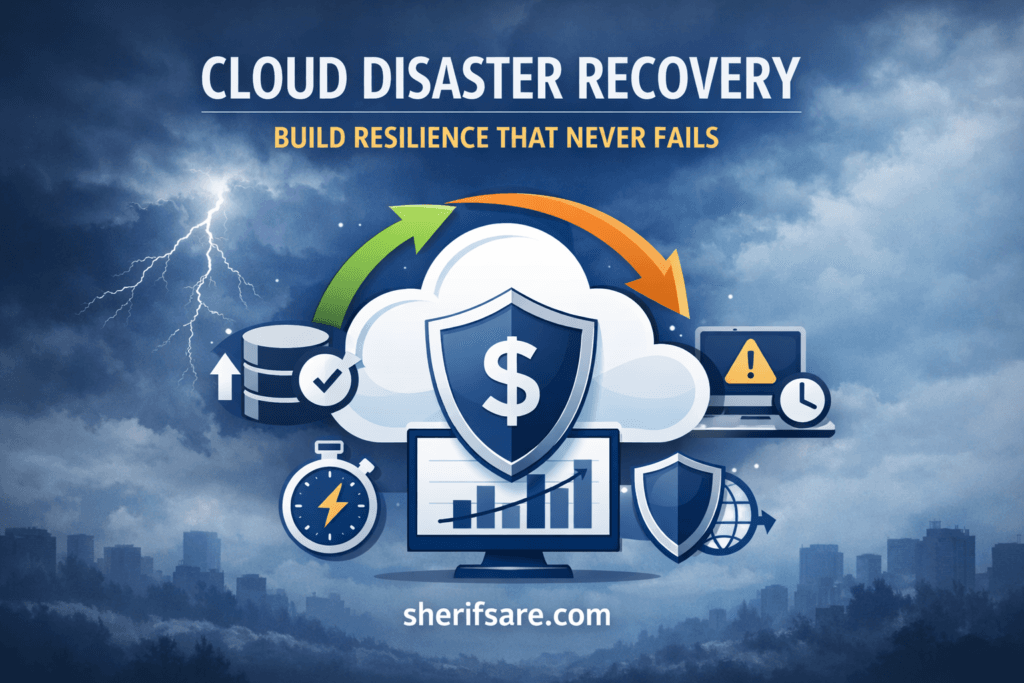
Table of Contents
- What Is Cloud Disaster Recovery?
- Why It Matters
- Types of Cloud DR Models
- Key Components
- Strategies and Architectures
- Tools and Services
- Real-World Use Cases
- Best Practices
- Common Pitfalls
- DR in Mining, Education, and E-Commerce
- Final Thought
1. What Is Cloud Disaster Recovery?
Cloud disaster recovery is the process of replicating and restoring data, applications, and infrastructure in the cloud after a disruption. It minimizes downtime and data loss while maintaining business continuity.
Core objectives:
- Rapid recovery
- Data integrity
- Minimal downtime
- Cost efficiency
2. Why Cloud Disaster Recovery Matters
- Business Continuity: Keeps operations running during outages.
- Data Protection: Prevents loss from cyberattacks or hardware failure.
- Compliance: Meets regulatory requirements for data retention.
- Customer Trust: Ensures reliability and uptime.
- Operational Efficiency: Reduces manual recovery time.
3. Types of Cloud Disaster Recovery Models
| Model | Description | Recovery Time Objective (RTO) |
|---|---|---|
| Backup & Restore | Simple data backup and manual restore | High (hours to days) |
| Pilot Light | Minimal environment kept running | Moderate (minutes to hours) |
| Warm Standby | Scaled-down version of production | Low (minutes) |
| Multi-Site Active-Active | Full redundancy across sites | Very Low (seconds) |
4. Key Components
- Replication: Continuous data synchronization.
- Storage: Durable, geo-redundant backups.
- Automation: Scripts and orchestration for failover.
- Monitoring: Real-time alerts and health checks.
- Testing: Regular DR drills and validation.
5. Strategies and Architectures
🔹 Multi-Region Deployment
- Distribute workloads across regions for redundancy.
🔹 Automated Failover
- Use load balancers and orchestration tools for instant recovery.
🔹 Immutable Backups
- Protect against ransomware by preventing backup modification.
🔹 Hybrid DR
- Combine on-premises and cloud recovery for flexibility.
🔹 Policy-Based Recovery
- Automate recovery workflows using predefined rules.
6. Tools and Services
| Tool/Service | Function |
|---|---|
| AWS Backup / CloudEndure | Automated backup and recovery |
| Azure Site Recovery | Orchestrated failover and replication |
| Google Cloud Backup & DR | Unified backup and restore |
| Veeam / Zerto | Multi-cloud replication and recovery |
| Datto / Druva | SaaS and endpoint protection |
| Terraform / Ansible | Infrastructure automation |
| CloudWatch / Prometheus | Monitoring and alerting |
7. Real-World Use Cases
🏦 Fintech
- Use multi-region replication for transaction data.
- Automate failover to secondary regions.
🛒 E-Commerce
- Maintain active-active architecture for storefronts.
- Use CDN failover for global availability.
🏫 Education Platforms
- Backup LMS data and student records.
- Automate restore for exam environments.
8. Best Practices
- Define RTO/RPO: Align recovery goals with business needs.
- Automate recovery: Use scripts and orchestration tools.
- Test regularly: Validate recovery workflows.
- Use immutable backups: Prevent tampering.
- Monitor continuously: Detect failures early.
- Document procedures: Ensure clarity during crises.
9. Common Pitfalls
- Unverified backups: Data may be incomplete or corrupted.
- Manual recovery: Slows down response time.
- Single-region dependency: Increases risk.
- Neglected testing: Leads to failed recovery.
Solutions:
- Automate, replicate, and test regularly.
10. Final Thought
Cloud disaster recovery isn’t just about surviving outages, it’s about thriving through them. Whether you’re running a startup, or an educational platform, resilience ensures your business never stops.
Next up: Cloud AI and Machine Learning; how intelligent systems transform data into decisions.

Great content! Keep up the good work!