Multi-cloud management empowers organizations to use services from multiple cloud providers like AWS, Azure, and Google Cloud while maintaining unified control, security, and performance. This post explores strategies, tools, challenges, and real-world applications for startups, mining operations, educational platforms, and beyond.
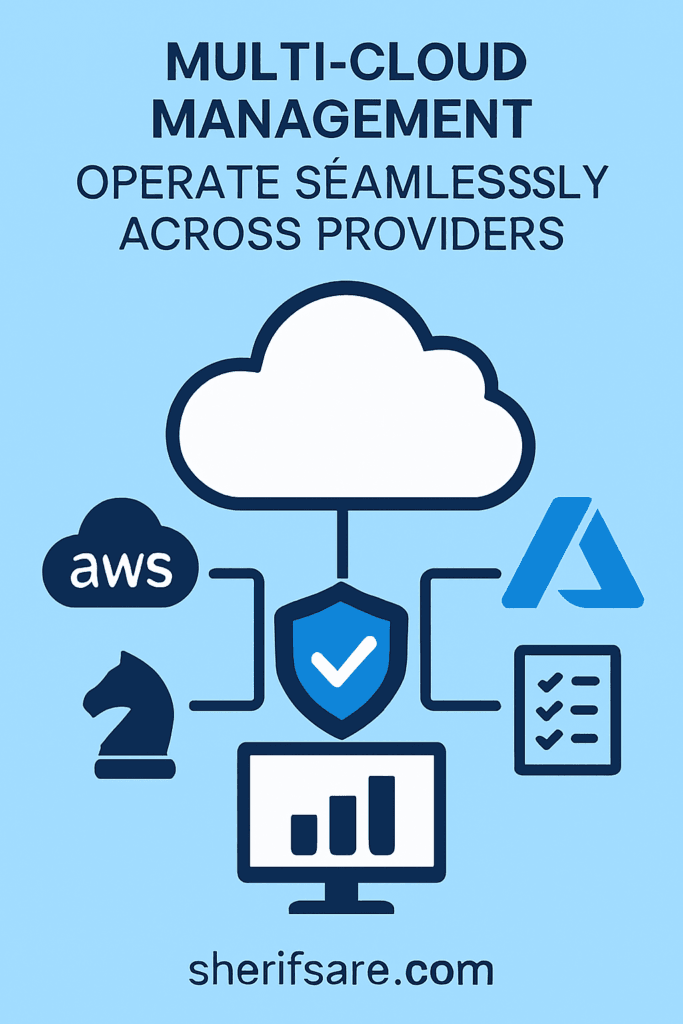
Table of Contents
- What Is Multi-Cloud Management?
- Why Go Multi-Cloud?
- Key Challenges of Multi-Cloud
- Strategic Approaches
- Tools and Platforms for Multi-Cloud Management
- Real-World Use Cases
- Best Practices
- Common Pitfalls
- Multi-Cloud in Mining, Education, and E-Commerce
1. What Is Multi-Cloud Management?
Multi-cloud management refers to the ability to monitor, control, and optimize workloads across multiple cloud platforms. It enables organizations to avoid vendor lock-in, leverage best-of-breed services, and build resilient architectures.
Core functions:
- Unified monitoring and analytics
- Cross-platform orchestration
- Identity and access management
- Cost optimization
- Security and compliance enforcement
2. Why Go Multi-Cloud?
- Avoid Vendor Lock-In: Flexibility to switch providers or use specialized services.
- Optimize Performance: Use region-specific services for latency-sensitive workloads.
- Enhance Resilience: Distribute workloads to avoid single points of failure.
- Cost Efficiency: Compare pricing and use spot/reserved instances across platforms.
- Compliance Flexibility: Meet regional data residency and regulatory requirements.
3. Key Challenges of Multi-Cloud
- Complexity: Managing multiple dashboards, APIs, and billing systems.
- Security Risks: Inconsistent policies across platforms.
- Data Integration: Synchronizing data across clouds.
- Skill Gaps: Teams may lack expertise in all platforms.
- Visibility: Hard to track usage and performance across providers.
4. Strategic Approaches
🔹 Abstraction Layers
- Use platforms that abstract cloud-specific APIs (e.g., Terraform, Pulumi).
🔹 Unified Identity Management
- Implement SSO and RBAC across providers.
🔹 Centralized Monitoring
- Use tools that aggregate metrics and logs from all clouds.
🔹 Policy-as-Code
- Enforce consistent governance using tools like Sentinel or Open Policy Agent.
🔹 Cloud Broker Models
- Use intermediaries to manage provisioning and billing.
5. Tools and Platforms for Multi-Cloud Management
| Tool/Platform | Function |
|---|---|
| Terraform | Infrastructure as code across clouds |
| Kubernetes | Container orchestration across providers |
| HashiCorp Consul | Service discovery and configuration |
| CloudHealth / CloudCheckr | Cost and governance analytics |
| Datadog / New Relic | Unified monitoring and observability |
| Okta / Azure AD | Identity and access management |
| Anthos / Azure Arc | Hybrid and multi-cloud app management |
| Aviatrix / Morpheus | Multi-cloud networking and automation |
6. Real-World Use Cases
🏦 Fintech
- Use AWS for compute, Azure for compliance tools, and GCP for analytics.
- Centralize monitoring and billing.
🛒 E-Commerce
- Host storefront on GCP, use AWS for inventory, and Azure for customer data.
- Implement unified IAM and logging.
🏫 Education Platforms
- Use GCP for ML workloads, Azure for LMS, and AWS for content delivery.
- Manage student access and data retention across clouds.
⛏️ Mining Operations
- Use AWS for sensor data ingestion, Azure for geospatial analysis, and GCP for simulation.
- Govern access and automate reporting.
7. Best Practices
- Define a multi-cloud strategy: Align with business goals and workloads.
- Use abstraction tools: Simplify deployment and management.
- Standardize policies: Apply consistent security and governance.
- Train teams: Build cross-platform expertise.
- Monitor everything: Use centralized dashboards and alerts.
8. Common Pitfalls
- Fragmented visibility: Leads to blind spots and inefficiencies.
- Inconsistent policies: Creates security and compliance risks.
- Overhead costs: Duplicate services and tools.
- Tool sprawl: Too many overlapping platforms.
Solutions:
- Consolidate tools.
- Use policy-as-code.
- Conduct regular audits.
9. Multi-Cloud in Mining, Education, and E-Commerce
⛏️ Mining
- Distribute workloads across clouds for resilience.
- Use centralized dashboards for field operations.
🏫 Education
- Manage student data across platforms.
- Use hybrid tools for LMS and content delivery.
🛒 E-Commerce
- Optimize cost and performance across storefront, inventory, and analytics.
- Enforce unified access and compliance.
Next
Multi-cloud isn’t just a trend; it’s a strategic advantage. It empowers organizations to innovate, scale, and stay resilient across platforms. Whether you’re running a startup, mining operation, or educational platform, multi-cloud management is your key to agility and control.