Metamorphic rocks are formed when existing rocks are transformed by heat, pressure, and chemical processes without melting.
They reveal Earth’s deep interior dynamics and are key to understanding mountain building, tectonics, and mineral formation.
What Are Metamorphic Rocks?
Metamorphic rocks originate from pre-existing rocks; either igneous, sedimentary, or older metamorphic rocks that undergo transformation due to:
- High temperature
- Intense pressure
- Chemical fluids
This process is called metamorphism, meaning “change in form.”
The Metamorphic Process
| Stage | Description |
|---|---|
| Burial | Rocks are buried deep by sediment or tectonics |
| Heating | Temperatures rise due to proximity to magma or geothermal gradient |
| Pressure | Compression from overlying rocks or tectonic forces |
| Recrystallization | Minerals reorganize into new structures |
| Foliation | Minerals align into bands under directional pressure |
Note: Rocks do not melt during metamorphism; that would produce igneous rocks.
Types of Metamorphism
1. Contact Metamorphism
- Occurs near magma intrusions
- Driven by heat, not pressure
- Produces non-foliated rocks
Example: Limestone → Marble near a granite intrusion
2. Regional Metamorphism
- Occurs over large areas
- Driven by pressure and temperature
- Common in mountain belts
- Produces foliated rocks
Example: Shale → Slate → Schist → Gneiss during continental collision
3. Dynamic Metamorphism
- Occurs along fault zones
- Driven by shear stress
- Produces mylonites and cataclasites
Example: Rocks crushed and deformed along the Akwapim Fault Zone
Metamorphic Rock Types and Their Origins
| Parent Rock | Metamorphic Rock | Texture | Notes |
|---|---|---|---|
| Shale | Slate | Foliated | Fine-grained, splits easily |
| Slate | Schist | Foliated | Visible mica flakes |
| Schist | Gneiss | Foliated | Banded minerals |
| Limestone | Marble | Non-foliated | Reacts with acid |
| Sandstone | Quartzite | Non-foliated | Very hard, interlocking grains |
Transformation Series: Shale → Slate → Schist → Gneiss shows increasing metamorphic grade.
Metamorphic Rocks in Ghana
Key Regions:
- Akwapim-Togo Range: Dominated by schists and gneisses
- Dahomeyan Belt: Contains high-grade metamorphic rocks
- Birimian Terrane: Hosts metamorphosed volcanic and sedimentary rocks
Economic Importance:
- Marble: Used in construction and sculpture
- Quartzite: Durable for road building
- Schist belts: Associated with gold deposits
Example: Gold exploration in Ghana often targets metamorphosed Birimian rocks.
Textures and Structures in Metamorphic Rocks
| Feature | Description | What It Indicates |
|---|---|---|
| Foliation | Alignment of minerals into bands | Directional pressure |
| Lineation | Linear features from stretching | Tectonic strain |
| Porphyroblasts | Large crystals in fine matrix | Growth during metamorphism |
| Migmatite | Mixed metamorphic and igneous textures | Partial melting |
Example: Garnet porphyroblasts in schist indicate high-grade metamorphism.
How Geologists Study Metamorphic Rocks
- Thin section analysis: Microscopic study of mineral textures
- X-ray diffraction: Identifies mineral phases
- Geothermobarometry: Estimates temperature and pressure conditions
- Field mapping: Traces metamorphic zones
- Isotope dating: Determines age of metamorphism
Example: Mapping metamorphic zones helps reconstruct tectonic history.
Why Metamorphic Rocks Matter
- Record tectonic events: Continental collisions, faulting, uplift
- Host valuable minerals: Gold, graphite, garnet
- Support infrastructure: Durable building materials
- Reveal Earth’s interior: Pressure-temperature paths
Metamorphic Grade and Index Minerals
| Grade | Temperature | Index Minerals | Example Rock |
|---|---|---|---|
| Low | ~200–400°C | Chlorite, biotite | Slate |
| Medium | ~400–600°C | Garnet, staurolite | Schist |
| High | ~600–800°C | Kyanite, sillimanite | Gneiss |
Note: Index minerals help geologists estimate metamorphic conditions.
What’s Next
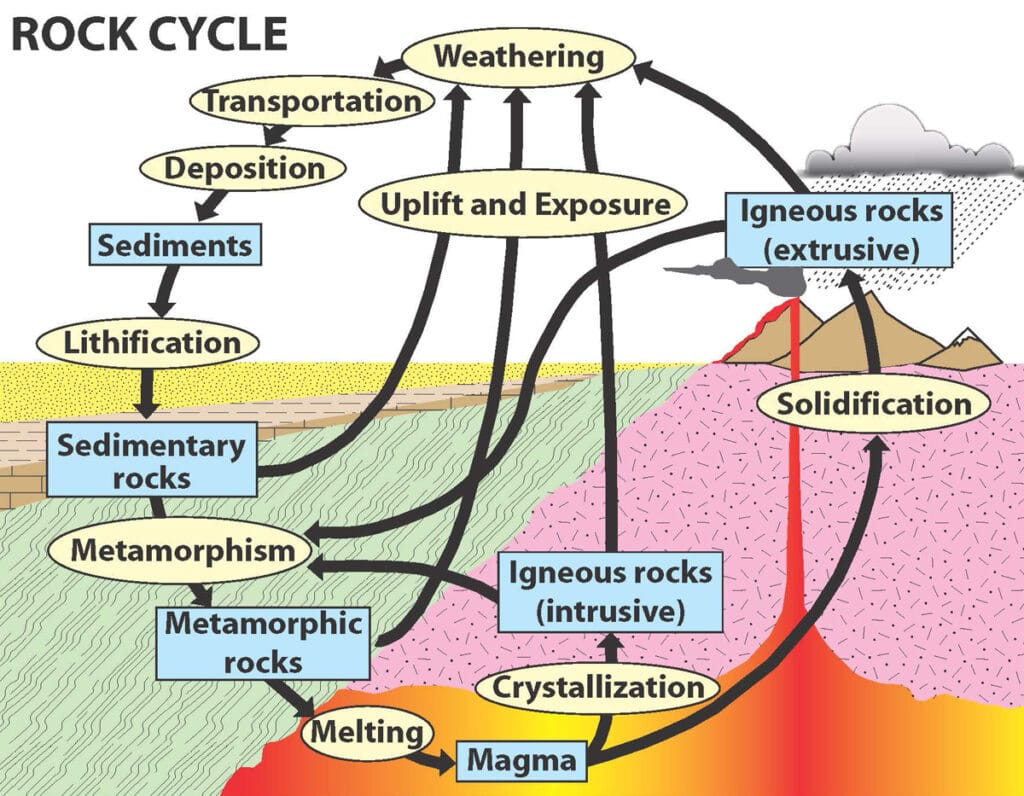
In the next post, we’ll explore The Rock Cycle and Earth’s Recycling System; how rocks continuously transform across geologic time.