Sedimentary rocks are formed from particles of other rocks, minerals, and organic material that settle in layers. Fossils are preserved remains or traces of ancient life, often found within these layers. Together, Sedimentary Rocks and Fossils record Earth’s environmental history and biological evolution.
What Are Sedimentary Rocks?
Sedimentary rocks are one of the three main rock types (alongside igneous and metamorphic). They form through the accumulation, compaction, and cementation of sediments.
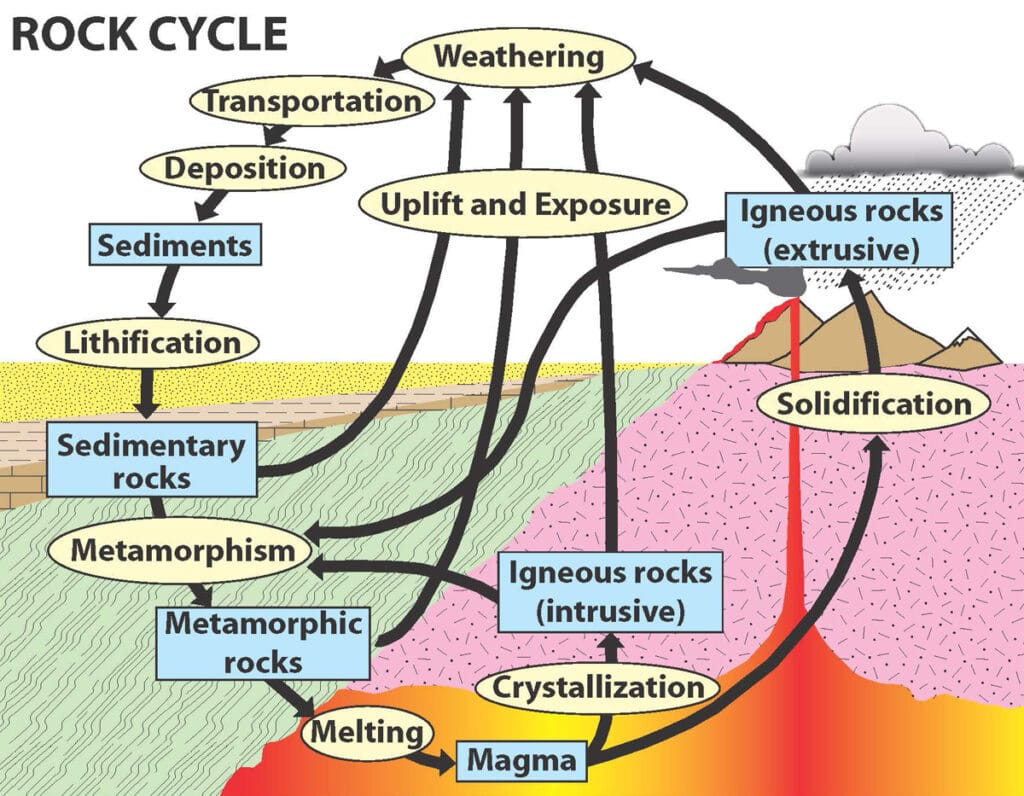
The Sedimentary Cycle:
- Weathering breaks down existing rocks.
- Erosion transports particles.
- Deposition settles them in basins.
- Compaction squeezes layers.
- Cementation binds particles into rock.
Types of Sedimentary Rocks
1. Clastic Sedimentary Rocks
Formed from fragments of other rocks.
| Rock Type | Grain Size | Example | Environment |
|---|---|---|---|
| Conglomerate | Coarse, rounded | Riverbeds | High-energy rivers |
| Sandstone | Medium, gritty | Desert dunes | Beaches, deserts |
| Shale | Fine, layered | Mudstone | Lakes, deep seas |
Example: Ghana’s Volta Basin contains extensive sandstone and shale formations.
2. Chemical Sedimentary Rocks
Formed from dissolved minerals precipitating out of solution.
| Rock Type | Composition | Example | Environment |
|---|---|---|---|
| Limestone | Calcium carbonate | Coral reefs | Marine settings |
| Halite | Sodium chloride | Rock salt | Evaporating lakes |
| Gypsum | Calcium sulfate | Plaster stone | Arid basins |
Example: Evaporite deposits in arid regions of northern Ghana.
3. Organic Sedimentary Rocks
Formed from accumulated biological material.
| Rock Type | Source Material | Example | Environment |
|---|---|---|---|
| Coal | Plant debris | Bituminous coal | Swamps |
| Chalk | Microorganisms | White cliffs | Deep marine |
Example: Though Ghana lacks major coal deposits, organic-rich shales exist in some basins.
Fossil Formation: Preserving Ancient Life
Fossils form when organisms are buried quickly and mineralized over time. Sedimentary rocks are ideal for fossil preservation because they form in low-temperature, low-pressure environments.
Types of Fossils:
- Body fossils: Bones, shells, teeth
- Trace fossils: Footprints, burrows, coprolites
- Molds and casts: Impressions and replicas
- Carbon films: Thin residue of organic material
Fossilization Process:
- Death and burial: Rapid burial prevents decay.
- Permineralization: Minerals fill pores in bones/shells.
- Replacement: Original material replaced by minerals.
- Compression: Organic material flattened into films.
- Uplift and exposure: Tectonics or erosion reveal fossils.
Example: Trilobites, ammonites, and leaf imprints are common in marine and deltaic sedimentary rocks.
Sedimentary Rocks and Fossils in Ghana
Key Regions:
- Volta Basin: Sandstone, shale, and fossiliferous layers
- Tano Basin: Marine sediments with potential fossil traces
- Keta Basin: Coastal deposits and organic-rich layers
Fossil Evidence:
- Microfossils: Foraminifera in marine shales
- Plant fossils: Leaf imprints in deltaic sediments
- Trace fossils: Ripple marks, mud cracks, burrows
Sedimentary Structures That Reveal History
| Structure | What It Indicates |
|---|---|
| Ripple marks | Water or wind movement |
| Mud cracks | Drying and exposure |
| Cross-bedding | Direction of sediment transport |
| Graded bedding | Energy changes in deposition |
| Bioturbation | Organism activity in sediment |
Example: Cross-bedding in Ghana’s sandstones shows ancient river flow directions.
How Geologists Study Sedimentary Rocks and Fossils
- Field mapping: Identifies rock units and fossil zones
- Core drilling: Extracts subsurface samples
- Thin section analysis: Microscopic study of rock texture
- Radiometric dating: Determines age of layers
- Paleontology: Studies fossil content and evolution
Example: Stratigraphic correlation helps link fossil layers across Ghana’s basins.
Why Sedimentary Rocks Matter
- Record Earth’s history: Climate, life, and environments
- Host natural resources: Oil, gas, coal, groundwater
- Guide exploration: Fossils help date and correlate layers
- Support construction: Sandstone and limestone used in buildings
What’s Next
In the next post, we’ll explore Metamorphic Rocks and Geological Transformation — how heat and pressure reshape Earth’s crust.