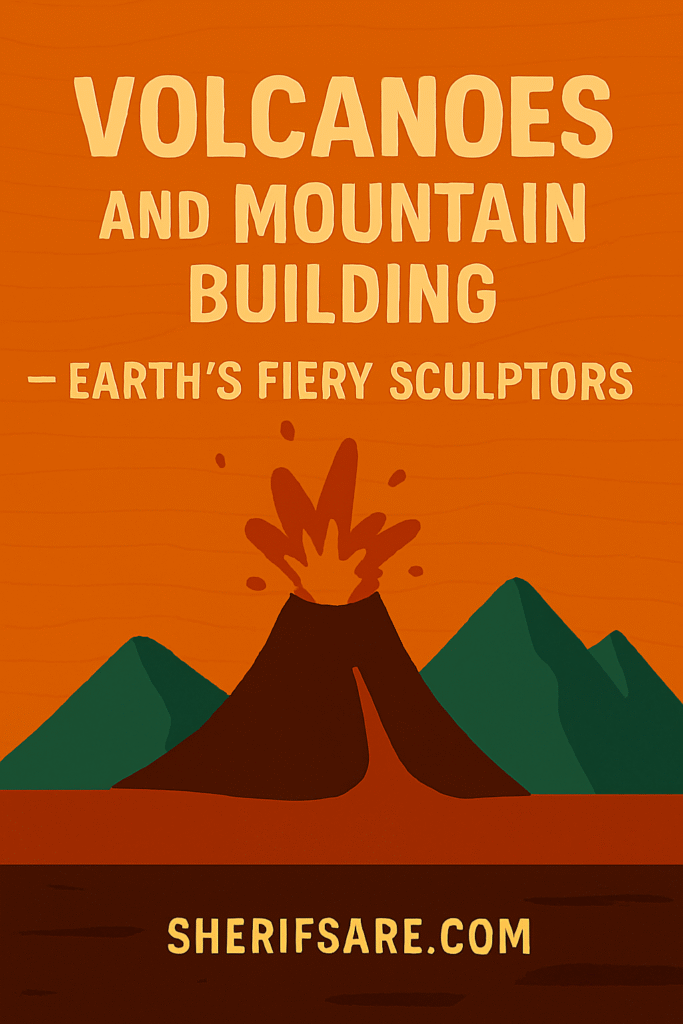
Volcanoes and mountains aren’t just dramatic landscapes — they reveal how Earth’s crust reshapes itself. These processes:
- Create new land
- Release gases that affect climate
- Concentrate valuable minerals
- Shape ecosystems and human settlement
Volcanoes: Fire from Below
| Type | Shape & Features | Example |
|---|---|---|
| Shield | Broad, gentle slopes; runny lava | Mauna Loa (Hawaii) |
| Stratovolcano | Steep, layered; explosive eruptions | Mount Fuji, Mount St. Helens |
| Cinder Cone | Small, steep; short-lived eruptions | Parícutin (Mexico) |
Mountain Building (Orogeny)
Mountains form when tectonic plates:
- Collide (convergent boundaries): crust crumples and uplifts
- Fold: layers bend into anticlines and synclines
- Fault: blocks shift vertically or horizontally
Ghana’s Mountain Context
- Ghana’s terrain is mostly low-lying, but the Akwapim-Togo Range shows uplifted Precambrian rocks.
- No active volcanoes, but ancient igneous intrusions exist in the Birimian rocks.
Volcanic Products
- Lava: molten rock on surface
- Ash: fine particles that can travel far
- Pyroclastic flows: deadly, fast-moving clouds of gas and debris
- Volcanic gases: CO₂, SO₂, H₂O — can affect climate and health
What’s Next
In the next post, we’ll explore Weathering and Erosion; how Earth’s surface breaks down and reshapes over time.