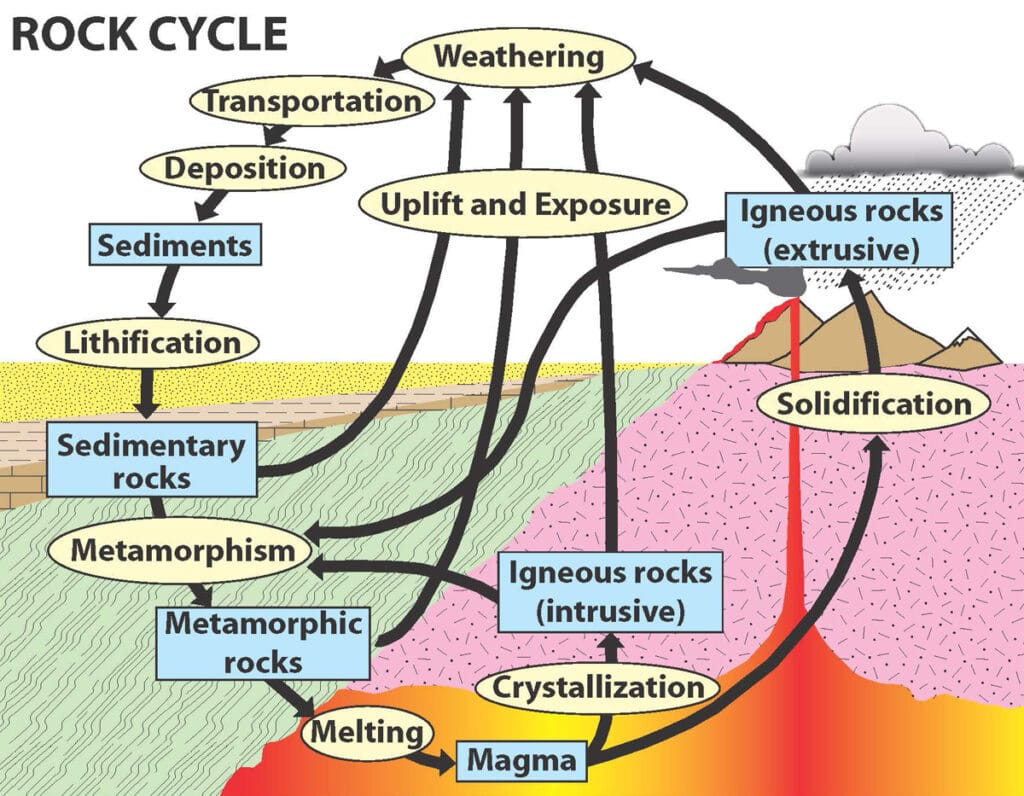
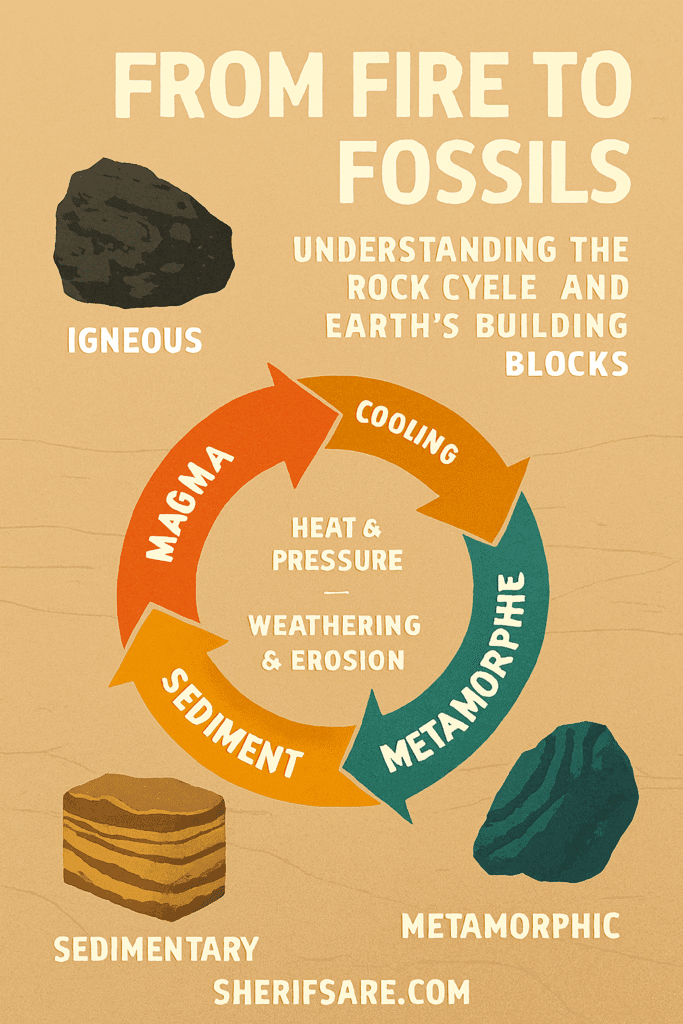
The rock cycle is Earth’s natural recycling system. It explains how rocks change from one type to another: igneous, sedimentary, and metamorphic, through processes like melting, cooling, weathering, erosion, burial, and heat/pressure.
This cycle is dynamic, non-linear, and ongoing, shaping Earth’s surface and interior over millions of years.
What Is the Rock Cycle?
The rock cycle describes how rocks are continuously transformed by geological processes. It’s not a closed loop; rocks can follow multiple paths depending on environmental conditions.
Key Processes:
- Melting → forms magma
- Cooling → forms igneous rocks
- Weathering & erosion → breaks rocks into sediments
- Deposition & lithification → forms sedimentary rocks
- Heat & pressure → forms metamorphic rocks
- Uplift & exposure → returns rocks to surface
Note: Any rock type can become another or even transform within its own category.
The Three Major Rock Types
1. Igneous Rocks
Formed from cooled magma or lava.
| Type | Formation | Example | Texture |
|---|---|---|---|
| Intrusive | Cooled underground | Granite | Coarse-grained |
| Extrusive | Cooled on surface | Basalt | Fine-grained |
Example: Volcanic rocks in Ghana’s Birimian terrane.
2. Sedimentary Rocks
Formed from compacted and cemented sediments.
| Type | Formation | Example | Texture |
|---|---|---|---|
| Clastic | Rock fragments | Sandstone | Layered |
| Chemical | Mineral precipitates | Limestone | Crystalline |
| Organic | Biological debris | Coal | Variable |
Example: Sandstones and shales in Ghana’s Volta Basin.
3. Metamorphic Rocks
Formed from existing rocks altered by heat and pressure.
| Parent Rock | Metamorphic Rock | Texture | Notes |
|---|---|---|---|
| Shale | Slate | Foliated | Fine-grained |
| Limestone | Marble | Non-foliated | Reacts with acid |
| Granite | Gneiss | Banded | High-grade |
Example: Schists and gneisses in the Akwapim-Togo Range.
How Rocks Transform
1. Igneous → Sedimentary
- Weathering breaks igneous rocks into particles
- Erosion transports them
- Deposition and lithification form sedimentary rocks
Example: Basalt cliffs eroding into beach sand
2. Sedimentary → Metamorphic
- Burial and tectonic pressure alter texture and mineralogy
- Heat from nearby magma accelerates transformation
Example: Shale → Slate → Schist in mountain belts
3. Metamorphic → Igneous
- Extreme heat melts metamorphic rocks into magma
- Magma cools to form new igneous rocks
Example: Gneiss melting into granite magma chamber
The Rock Cycle in Ghana
Regional Highlights:
- Birimian Terrane: Igneous and metamorphic rocks hosting gold
- Volta Basin: Sedimentary rocks with fossil traces
- Dahomeyan Belt: High-grade metamorphic zones
- Akwapim-Togo Range: Uplifted metamorphic rocks
Economic Importance:
- Gold: Found in metamorphosed volcanic belts
- Limestone: Used in cement and construction
- Granite: Quarried for building stone
Rock Cycle Drivers
| Driver | Role in Cycle |
|---|---|
| Plate tectonics | Uplift, subduction, pressure |
| Weather & climate | Erosion, sediment transport |
| Volcanism | Magma generation, surface cooling |
| Biological activity | Soil formation, organic sedimentation |
Example: Tropical rainfall in Ghana accelerates weathering and sediment formation.
Studying the Rock Cycle
- Field mapping: Tracks rock types and transitions
- Petrography: Microscopic study of textures
- Geochemistry: Analyzes mineral composition
- Radiometric dating: Determines age of transformations
- GIS and remote sensing: Visualizes rock distribution
Example: Mapping metamorphic zones helps locate mineral resources.
Why the Rock Cycle Matters
- Explains Earth’s dynamic nature
- Guides resource exploration
- Supports environmental studies
- Connects surface and deep Earth processes
- Educates about sustainability and change
What’s Next
In the next post, we’ll explore Minerals and Crystals; Earth’s Building Blocks and the substances that make up all rocks and define their properties.