Functions in programming are the backbone of clean, reusable code.
They let you break big problems into small, manageable pieces and give your code structure, clarity, and power.
1. What Is a Function in Programming?
A function is a named block of code that performs a specific task. You define it once, and you can use it as many times as you want, without rewriting the same logic.
🔍 Basic Anatomy of a Function
In Python, a function looks like this:
def greet():
    print("Hello, world!")
def— keyword to define a functiongreet— name of the function()— parentheses for parameters (empty here):— colon to start the block- Indented code — the body of the function
To run the function, you “call” it:
greet()
2. Why Functions Matter
- Reusability: Write once, use many times
- Organization: Break complex tasks into smaller steps
- Readability: Make your code easier to understand
- Testing: Test parts of your code independently
- Collaboration: Share logic across teams and projects
3. Creating Functions with Parameters
Functions can accept inputs — called parameters — to make them flexible.
def greet(name):
    print(f"Hello, {name}!")
Now you can personalize the greeting:
greet("Sherif")
greet("Amina")
4. Returning Values from Functions
Functions can also send back results using the return keyword.
def add(a, b):
    return a + b

result = add(3, 5)
print(result)  # Output: 8
This lets you store and reuse the output.
5. Real-Life Analogy
Think of a coffee machine:
- You press a button (call the function)
- You choose your drink (pass parameters)
- The machine makes it (runs the code)
- You get your coffee (return value)
6. Built-in vs. User-Defined Functions
- Built-in functions are provided by the language (e.g.,
print(),len(),type()) - User-defined functions are ones you create yourself
You can also import functions from libraries:
import math
print(math.sqrt(16))  # Output: 4.0
7. Function Scope — Where Variables Live
Variables inside a function are local — they don’t affect the rest of your code.
def show():
    message = "Hello"
    print(message)

print(message)  # Error: message is not defined
To use a variable outside the function, return it or define it globally (with caution).
8. Recursion — Functions That Call Themselves
Some functions solve problems by calling themselves. This is called recursion.
Example: factorial of a number
def factorial(n):
    if n == 1:
        return 1
    else:
        return n * factorial(n - 1)
Recursion is powerful but must have a base case to stop.
9. Practical Function Examples
✅ Convert Celsius to Fahrenheit
def c_to_f(celsius):
    return (celsius * 9/5) + 32
✅ Check if a Number Is Even
def is_even(n):
    return n % 2 == 0
✅ Find the Maximum of Three Numbers
def max_of_three(a, b, c):
    return max(a, b, c)
10. Best Practices for Writing Functions
- Use descriptive names —
calculate_tax()is better thanct() - Keep functions short — ideally under 20 lines
- Avoid side effects — don’t change global variables unless necessary
- Document your functions — use comments or docstrings
def greet(name):
    """Greets the user by name."""
    print(f"Hello, {name}!")
11. Function Exercises for Mastery
- Write a function that returns the square of a number
- Write a function that checks if a string is a palindrome
- Write a function that returns the sum of all numbers in a list
- Write a function that converts minutes to hours and minutes
- Write a function that returns the longest word in a sentence
12. Visualizing Functions
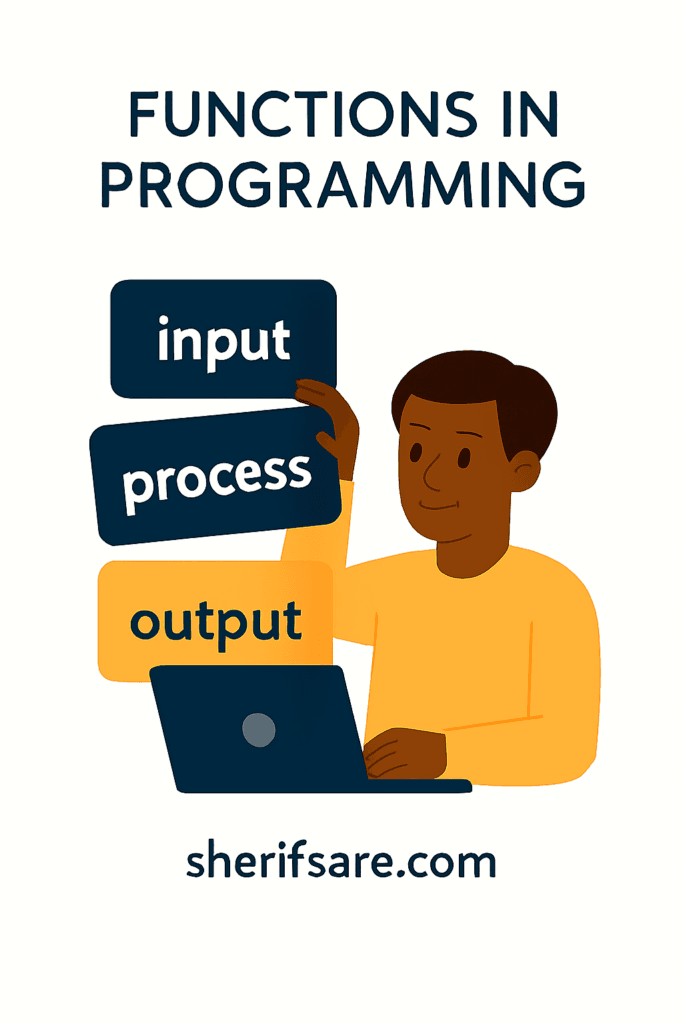
Imagine a flowchart:
- Start → Input → Run code → Return output → End
This helps beginners understand how functions work step by step.
13. What’s Next?
In the next post, we’ll explore lists and arrays — how to store multiple values and work with collections of data.