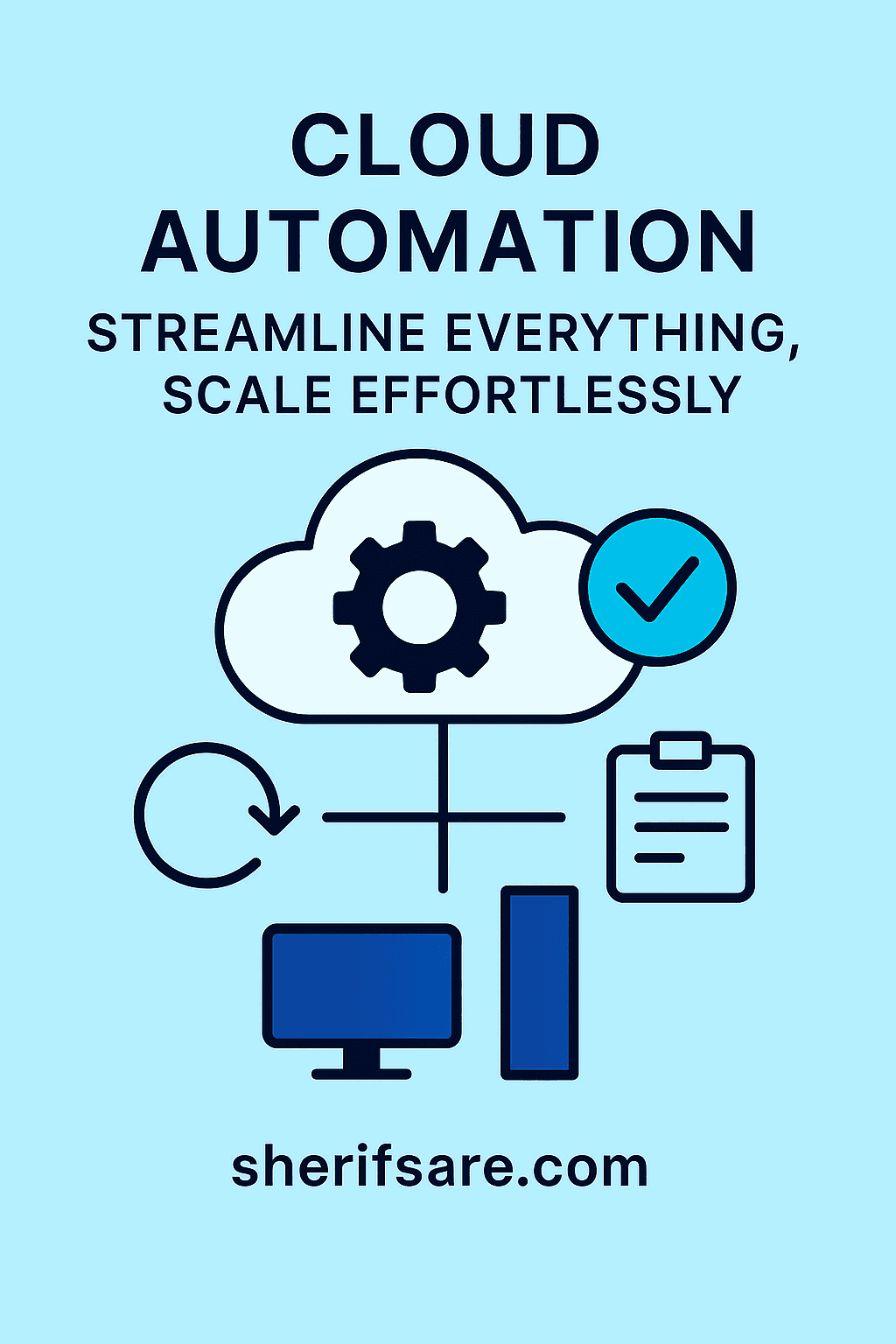
Cloud automation empowers teams to manage infrastructure, deploy applications, and respond to system events with minimal manual intervention. This post explores automation tools, strategies, real-world use cases, and best practices for startups, mining operations, educational platforms, and beyond.
Table of Contents
- What Is Cloud Automation?
- Benefits of Cloud Automation
- Key Cloud Automation Strategies
- Tools and Services for Cloud Automation
- Real-World Use Cases
- Best Practices
- Common Pitfalls
- Final Thought
1. What Is Cloud Automation?
Cloud automation refers to using software and scripts to manage cloud infrastructure, services, and workflows without manual intervention. It enables dynamic provisioning, scaling, monitoring, and recovery across cloud environments.
Core functions:
- Infrastructure provisioning
- Configuration management
- Continuous integration and deployment (CI/CD)
- Monitoring and alerting
- Auto-scaling and healing
2. Benefits of Cloud Automation
- Speed: Rapid deployment and scaling.
- Consistency: Eliminates human error and ensures repeatable processes.
- Cost Efficiency: Reduces idle resources and manual overhead.
- Resilience: Enables self-healing systems and proactive alerts.
- Agility: Supports DevOps, CI/CD, and rapid experimentation.
3. Key Cloud Automation Strategies
🔹 Infrastructure as Code (IaC)
- Define infrastructure using code (e.g., Terraform, AWS CloudFormation).
- Enables version control and repeatable deployments.
🔹 Event-Driven Automation
- Trigger actions based on system events (e.g., CPU spike triggers auto-scaling).
🔹 Scheduled Automation
- Run tasks at specific times (e.g., backups, updates).
🔹 Workflow Orchestration
- Coordinate multi-step processes across services (e.g., data pipelines, ML workflows).
🔹 Auto-Healing
- Detect failures and restart services automatically.
4. Tools and Services for Cloud Automation
| Tool/Service | Function |
|---|---|
| Terraform | Infrastructure as code |
| AWS CloudFormation | IaC for AWS |
| Azure Automation | Scheduled tasks and runbooks |
| Google Cloud Composer | Workflow orchestration |
| Jenkins / GitHub Actions | CI/CD pipelines |
| Kubernetes | Container orchestration |
| Ansible / Chef / Puppet | Configuration management |
| CloudWatch / Datadog | Monitoring and alerting |
Sources: AWS, Azure, Google Cloud, HashiCorp, CNCF
5. Real-World Use Cases
Fintech
- Automate deployment of microservices.
- Monitor fraud detection pipelines with event-based triggers.
E-Commerce
- Auto-scale during flash sales.
- Automate inventory updates and customer notifications.
Education Platforms
- Schedule backups and updates during off-hours.
- Automate student onboarding and access provisioning.
Mining Operations
- Automate sensor data ingestion and geospatial analysis.
- Trigger alerts for equipment anomalies or environmental thresholds.
6. Best Practices
- Use modular IaC templates: Promote reuse and clarity.
- Implement version control: Track changes and rollbacks.
- Test automation scripts: Validate before deployment.
- Monitor automation outcomes: Use dashboards and alerts.
- Secure automation credentials: Use vaults and role-based access.
7. Common Pitfalls
- Over-automation: Complex systems become hard to debug.
- Poor documentation: Makes onboarding and troubleshooting difficult.
- Ignoring security: Automation scripts can expose sensitive data.
- Lack of observability: Hard to trace failures without logs and metrics.
Solutions:
- Document workflows.
- Use observability tools.
- Review automation regularly.
8. Final Thought
Cloud automation isn’t just about efficiency; it’s about empowerment. It frees teams to focus on innovation, not maintenance. Whether you’re running a startup, mining operation, or educational platform, automation is your key to scaling smart.
In our next post, we’ll explore cloud monitoring and how to stay proactive with performance, security, and cost.