Why Geologic Time Matters
Understanding geologic time allows us to:
- Reconstruct ancient environments
- Date rock formations and fossils
- Track climate change and mass extinctions
- Understand how life evolved
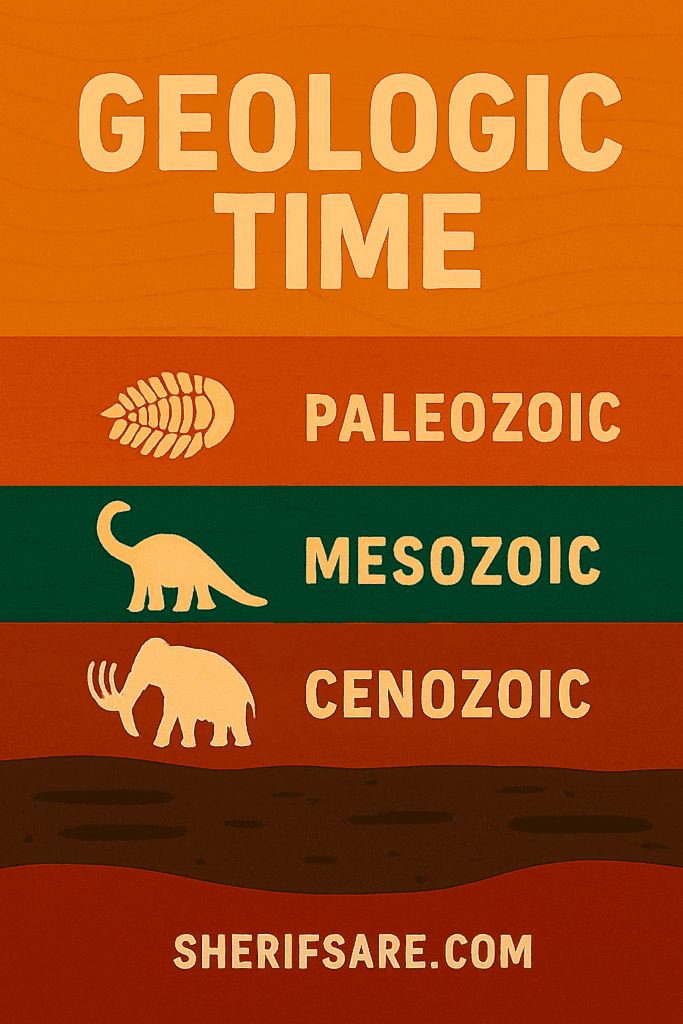
Earth is about 4.6 billion years old. That’s a timescale far beyond human history and geology helps us read that deep past through rocks, fossils, and layers.
The Geologic Time Scale
| Eon | Era | Period | Key Events |
|---|---|---|---|
| Phanerozoic | Cenozoic | Quaternary | Humans evolve, Ice Ages |
| Paleogene | Mammals diversify | ||
| Mesozoic | Cretaceous | Dinosaurs go extinct | |
| Jurassic | Dinosaurs dominate | ||
| Triassic | First dinosaurs, mammals | ||
| Palaeozoic | Permian | Mass extinction | |
| Carboniferous | Coal-forming forests | ||
| Devonian | First amphibians | ||
| Silurian | First land plants | ||
| Ordovician | Marine life diversifies | ||
| Cambrian | Explosion of life forms | ||
| Precambrian | — | — | Formation of Earth, early life |
Fossils: Clues from the Past
Fossils are preserved remains of ancient life. They help geologists:
- Date rock layers (biostratigraphy)
- Understand past climates and ecosystems
- Trace evolution and extinction events
Dating Rocks and Fossils
- Relative Dating: Determines sequence (older vs younger) using rock layers and fossils
- Absolute Dating: Uses radioactive decay (e.g., carbon-14, uranium-lead) to assign actual ages
Ghana’s Geologic History
- Birimian rocks (2.1–2.2 billion years old) host gold deposits
- Voltaian Basin preserves sedimentary records of ancient environments
- Togo and Dahomeyan belts show evidence of early crustal formation
What’s Next
In the next post, we’ll explore Plate Tectonics and Earthquakes; how Earth’s crust moves and reshapes the planet.